Central Park
City of GodCentral Park is presented as more than a recreational space: it is a concentrated image of New York City as a living system, where strangers, families, commerce, infrastructure, birds, and ants occupy overlapping networks of movement and attention. Its decisive significance lies in the way it makes urban collectivity perceptible. The park permits intimate scenes of family play and observation while also enlarging them into meditations on mass society, animal organization, and the possibility of an aggregate intelligence beyond any single individual.
Setting and Urban Life
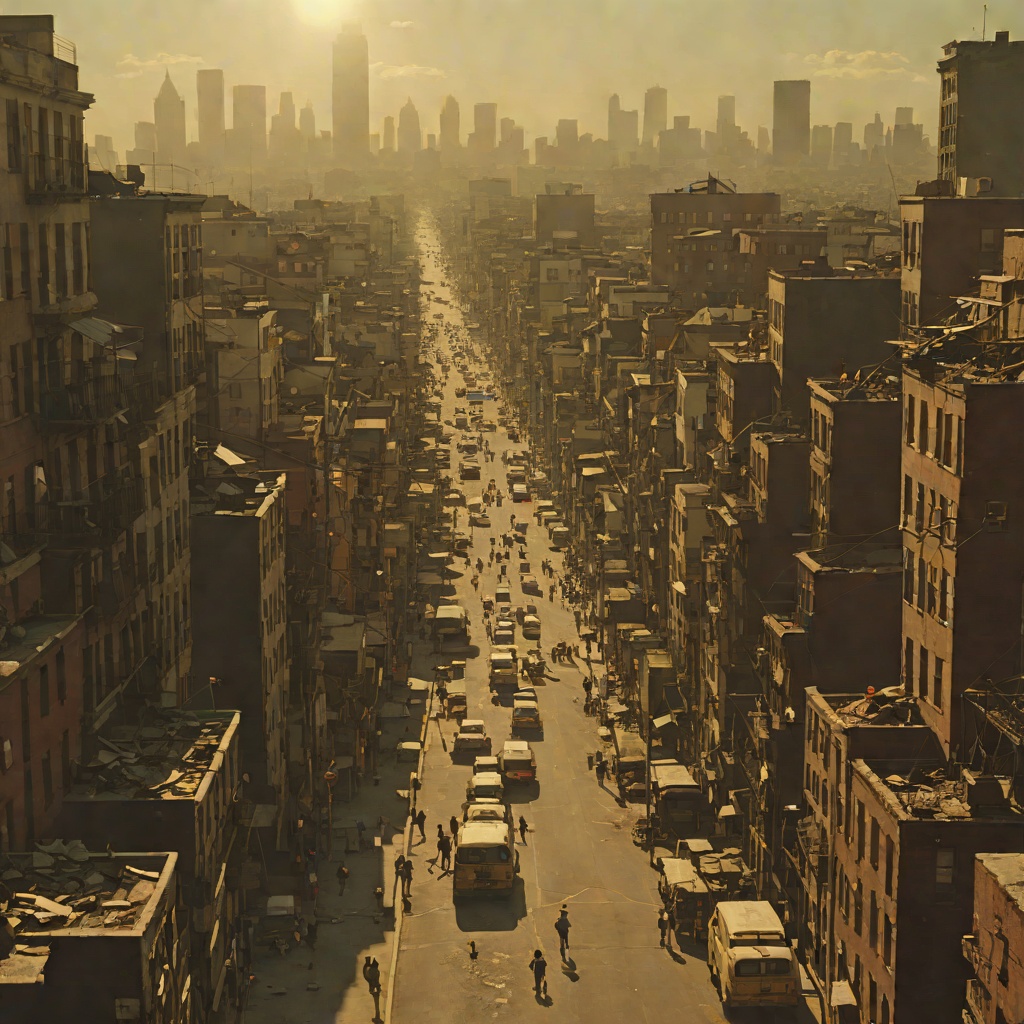
Central Park gathers the city’s scale into a walkable landscape of lawns, winding paths, roadways, lakes, and residential towers. On a warm Sunday afternoon, the park is crowded with people celebrating the weather, yet the crowd is not represented as a faceless mass. The narrator watches individuals, couples, families, and children whose movements seem random and whose next actions cannot be predicted. At the same time, the collective presence of thousands makes each person’s identity legible. The park therefore reproduces the larger experience of New York City, where people rely on the strangers around them to delineate themselves even while negotiating public space with wariness or indifference.
The park also connects leisure to the material systems that sustain metropolitan life. In the Sunday scene, the sound and sight of Fifth Avenue’s residential towers enter the children’s play when Pem points out how sunlight flashes in their windows. The towers become a kind of urban clock, allowing the movement of the sun to register through architecture rather than through a natural horizon. Elsewhere, the narrator’s city walk passes Union Square Park, where rat-poison warnings stand in the grass beside the farmers’ market. That juxtaposition of poison, flowers, produce, buyers, sellers, traffic, and emergency sirens presents the city as an environment in which cultivation, commerce, danger, and bodily survival are never far apart.
Family Gathering at Sheep Meadow
Central Park is the setting for a Sunday meeting between Pem, Sarah, Sarah’s boys, the narrator, and Miss Warren, a freelance magazine writer from New Orleans. They meet at a specified tree near the western edge of Sheep Meadow, then stroll, watch softball, find a grassy place, unwrap deli heroes, and uncork Snapples. The scene begins as a carefully arranged attempt at balmy, ritual relaxation, but the surrounding mood is marked by a sense of loss and a melancholy that no single event fully explains.
The gathering exposes the unequal pressures within an apparently casual social occasion. The boys, wearing baseball mitts, are ready to imitate the larger players they have seen, while Pem rolls up his sleeves and organizes an imaginary game. He praises successful catches and throws and encourages the boy who drops the ball; Sarah watches as the older boy, Jake, now nine, appears physically changed since the narrator last saw him. The details of hair, skin, age, clothing, and gesture make the family’s continuity visible, but they also sharpen the narrator’s unease about bringing Miss Warren into this intimate circle after knowing her for only a week. Central Park thus becomes a stage on which friendship, family history, social performance, and private misgiving coexist without resolving one another.
Birds and the City of Birds
The park’s human scene is set against a larger vision of urban ecology. The narrator imagines Valdemingomez, an enormous garbage dump north of Madrid, as the City of Birds, an urban aviary containing more than one hundred thirty species. Storks, hawks, egrets, linnets, kites, jackdaws, ravens, condors, turkey buzzards, and occasional tropical visitors remain there because the dump supplies an environment that makes migration unnecessary. Their nests are lined with cassette tape, eggs are laid in old Big Mac containers, and songbirds move through rusty cans while grackles shelter in television cabinets.
This avian city does not merely decorate a human landscape; it reverses the usual hierarchy between city and nature. Waste becomes habitat, discarded consumer objects become nesting materials, and the dump develops its own population, soundscape, and logic of permanence. Flocks of rock doves moving over fields of chicken bones produce a composite noise compared to train tracks, wind chimes, shuffled cards, a bongo and bop rhythm, and a hot marimba band. The result is an image of life adapting to the remains of human production, with the nonhuman world generating an urban order that is neither planned nor controlled by human intention.
The Ant Colony and Collective Intelligence
During the same Sunday in Central Park, the boys discover a population of brown ants in dirt beneath a tree. The narrator kneels with them and watches creatures less than an eighth of an inch long build an underground city. Two or three trails radiate from the mound; ants going in opposite directions sometimes collide, wave their antennae, exchange chemical messages, and continue or reverse their routes. Their minuteness contrasts with the complexity and apparent purpose of their society.
The ants’ organization is described through work and social differentiation. Egg tenders, warriors, guards, and food gatherers contribute to the general welfare, while the queen’s fecundity determines the future of the colony. Yet an individual ant may never see the queen and may encounter no particular fellow ant more than once. The colony nevertheless remains unified through instructions passed antenna to antenna, without any visible central decision-making mechanism. The narrator compares this arrangement to parallel processors and to the human cortical structure, imagining an invisible organ of aggregate thought located somewhere above and around the ants, beyond the understanding of any one member.
The contrast between Central Park ants and larger ants elsewhere broadens the comparison. These local ants are characterized as domesticated, modest creatures, analogous to house sparrows within the ant species. Other ants in jungles, rain forests, and veldts build bridges from leaves, cultivate crops, float across rivers on rafts, march, make war, eat meat, and bite fiercely. They possess a collective sense of their anthood, perhaps even a degree of self-esteem. The park colony therefore becomes a point of departure for thinking about scales of intelligence: a small, ordinary society can reveal the same structural mystery as a vast human city.
Narrative Significance
Central Park binds together the book’s recurring interest in crowds, animal life, and the limits of individual knowledge. In the city’s public spaces, one person can appear autonomous and unpredictable, but the movement of many people suggests a pattern no single participant can see. The ants offer a nonhuman version of the same problem: each body performs a limited task, yet the colony responds coherently as though guided by a mind that has no identifiable location.
The park also gives this idea an emotional and social form. Children playing baseball, adults eating lunch, sunlight moving across towers, and ants crossing trails all belong to different orders of experience, but the narrative places them within one field of attention. Human life is neither dissolved into nature nor set wholly apart from it. Instead, Central Park becomes a visible assemblage in which architecture, weather, food, family, crowds, insects, and memory interact. Its deepest function is to make the city seem simultaneously accidental and purposeful: a place where individuals cannot apprehend the whole, yet where the whole continually emerges from their movements.